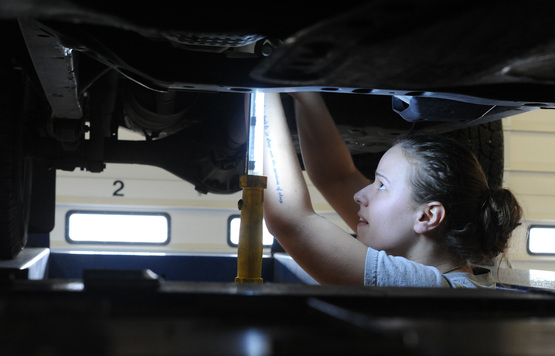








Straight Ahead (Wheel Alignment)
June 6, 2021
If every road was straight and smooth, we wouldn't have to worry much about wheel alignment. But they're not, so we do. Hitting potholes or driving on rough pavement can knock your vehicle out of alignment and you'll notice it in one of several ways.
Your steering wheel may not be centered when you're driving straight ahead, or your vehicle may pull to one side. You may find your tires wearing on one side or they may squeal. All are signs that could point to you needing an alignment.
Your wheels should be perpendicular to the road and parallel with each other. If not, your tires will wear out faster and your vehicle won't go straight on a level straightaway.
In alignment, there are several factors that must be checked. One is camber. Your wheels should be straight up and down if you look at them from the front. If not, you'll wear your tires unevenly on one side.
Another factor is caster, the angle of the steering pivot. Most vehicles have what's called positive caster, when the top of the steering pivot leans toward the rear. Proper caster balances steering effort, stability on the highway and cornering.
You may have heard the term "toe" in reference to your wheels. If you looked at your front wheels from straight above, for example, imagine your wheels were your feet. If you were to turn your toes in toward each other, that would be toeing in. The toe of your vehicle should be set to manufacturer's specifications so your vehicle handles well and doesn't prematurely wear out tires.
It's a good idea to have your alignment checked periodically since it can get knocked out by one hard knock or a lot of little knocks. It's not just about tire wear, it's about ride comfort and safe handling. You may say a vehicle aligned just feels divine.
ABC Auto Works
127 E. Walled Lake Drive
Walled Lake, Michigan 48390
800-742-4511
Need Service?
More articles from ABC Auto Repair & Tire Center
The Car Fluid Most Drivers Forget—And Why It Matters
October 25, 2026
Heres an automotive part you might not be familiar withthe differential. Its a component that transfers power from the driveshaft to the wheels. Its called a differential because the left and right drive wheels travel at different speeds when you make a turn. During that turn, the wheel on the ... More
A Sensor that Makes Sense
October 23, 2026
Theres an electronic device in your vehicle you may not even know about: the oxygen sensor. Your vehicle probably has more than one of them, and these oxygen sensors help your vehicle burn fuel efficiently, reduce emissions and protect important parts in your engine. An oxygen sensor senses how... More
Let's Clear the Air
October 11, 2026
So, back in the 1970s, automakers started equipping vehicles with a device that reduces harmful emissions before they even go out the tailpipe. Theyre called catalytic converters, and while they will likely last you years on your vehicle, they do wear out and eventually need to be replaced. Cat... More