






How Much is Enough for Walled Lake Auto Owners? Tire Tread Depth
April 17, 2018
Most Walled Lake drivers know that tires wear out and that the wear has to do with tread depth. Most of us have heard that “bald” tires are dangerous, but most of us picture a tire with no tread at all when we think of a bald tire. And when we take our vehicles in for preventive maintenance, the technician tells us they're need to be replaced long before all the tread is worn off. Just how much tire tread wear is too much? And how can you tell? Tires are and their condition is important to the safe handling of a vehicle, so it's for Walled Lake vehicle owners to know the answers to these questions.
First of all, it's important to understand that there may be a legal limit to tread wear. If your tires are worn past this limit, you have to replace them to be in compliance with Michigan auto safety laws. That's why measuring your tread wear is part of a vehicle safety inspection.
In some jurisdictions, tread must be at least 1.6 millimeters or 2/32 of an inch thick. This standard has been in effect since 1968. But this standard has recently been called into question, and some Michigan professionals are arguing that it be changed.
The safety issue that has brought this standard under scrutiny is the ability of a vehicle to stop on a wet surface. When a vehicle has trouble stopping, most Walled Lake drivers immediately look at the brakes as the source of the problem. But tires are crucial to safe stopping distances because they provide the traction required in a stop.
A tire's contact with the road surface creates traction, which allows for effective braking. On a wet surface, a tire only has traction if it can get to the road's surface. So tire tread is designed to channel water out from under the tire to allow it to stay in contact with the road. If the tire can't shift the water, then it starts to “float.” This condition is called hydroplaning. It is very dangerous for Walled Lake drivers since the vehicle won't stop no matter how hard the driver presses the brakes. Steering control is also lost.
A recent study tested the stopping ability of a passenger car and a full-sized pick-up on a road surface covered with only a dime's depth of water (less than a millimeter). The vehicles were traveling at 70 mph (112 kph) when they stopped on the wet surface. At 2/32 (1.6 mm) tread depth, the stopping distance was double that of a new tire. The passenger car was still traveling at 55 mph (89 kph) when it reached the stopping distance it experienced with new tires.
Let's suppose that you're on a busy Walled Lake road in a light drizzle and a vehicle stops suddenly in front of you. You just bought new tires and you brake hard, missing the vehicle with only inches to spare. If you hadn't bought those new tires, you would have crashed into that vehicle at 55 mph (89 kph). That is a major difference.
What if your tires had a tread depth of 4/32 (3.2 mm)? You would have crashed into that vehicle at 45 mph (72 kph). Still not a good situation. But it's better.
Now what if you were driving that pick-up truck? You wouldn't have missed that vehicle in the first place, and you would have crashed at higher rates of speed in both of the other scenarios. The heavier your vehicle, the longer its stopping distance. It's a matter of physics.
The results of this test has led Consumer Reports and others to ask that the standard for tread wear be changed from 2/32 (1.6 mm) to 4/32 (3.2 mm). The increased standard will improve safety on the road and save lives here in Michigan and nationally.
Of course, until the standard changes, you'll have to decide whether you'll be willing to replace your tires a little sooner.
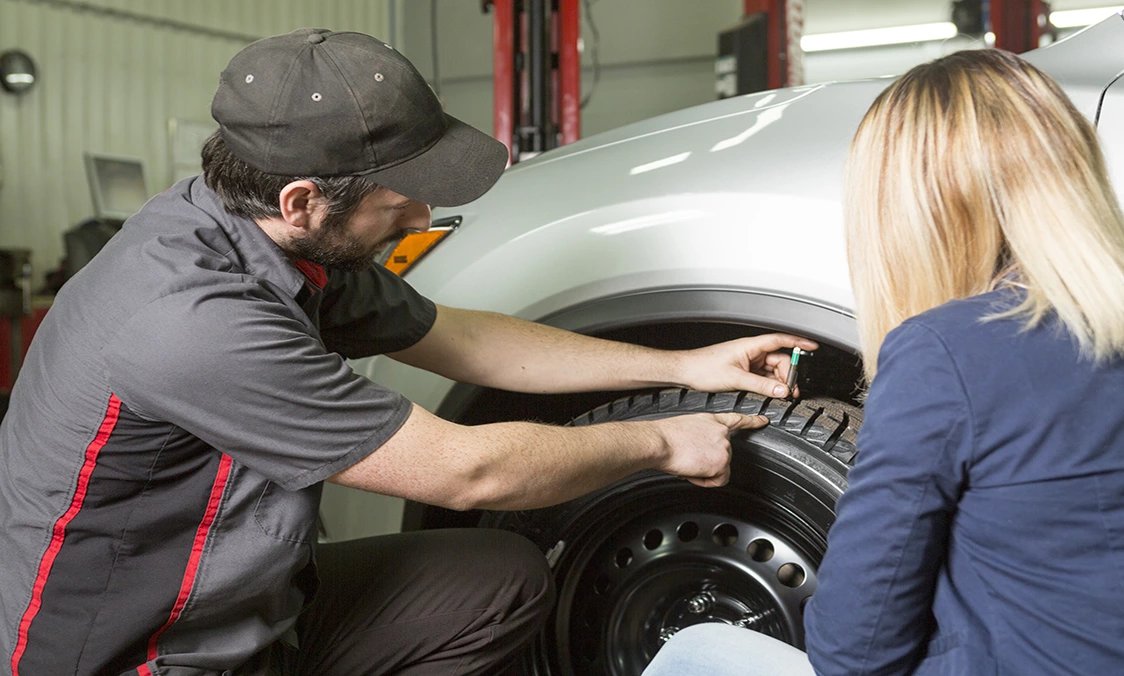
You can use an American quarter to tell if your tread wear is down to 4/32 (3.2 mm). Place the quarter into the tread with George's head toward the tire and his neck toward you. If the tread doesn't cover George's hairline, you're under 4/32 (3.2 mm). With a Canadian quarter, the tread should cover the digits of the year.
You can measure the 2/32 inch (1.6 mm) tread wear with a penny. If the tread touches the top of Abe's head, it's at 2/32 (1.6 mm). Tires are super important when it comes to vehicle care. But their condition has a major impact on safety. We need to decide whether to sacrifice safety for economy. Keeping our tread wear above 4/32 in (3.2 mm) is good auto advice.
ABC Auto Works
127 E. Walled Lake Drive
Walled Lake, Michigan 48390
800-742-4511
abc-auto-works.autotipsblog.com
Need Service?
More articles from ABC Auto Repair & Tire Center

That Clunk Isn’t Normal: Why Your U-Joints Need Lubrication (Lubricate U-Joints)
July 26, 2026
If youve noticed a clunk when shifting from park to drive, accelerating from a stop or letting off on your accelerator, it may be your vehicle warning you about dry or failing U-joints. Those are small, critical components in your drivetrain that allow the driveshaft to flex as your suspension mo... More
Timing Cover Replacement
July 19, 2026
Your engine has a lot of parts that need to work in harmony in order to keep you powering down the road. Some of those parts need to be protected in order to keep things running smoothly, and one that does the job is called a timing cover. It is in the front of your engine and shields components... More
Cabin Air Filter Replacement
July 12, 2026
How many times have you heard, You should replace your cabin air filter, and decided, Ill do it later. You might think twice when you consider a new filter can help maintain and improve the quality of the air youre breathing inside your vehicle. What you also might not know is it a clean cabin ... More