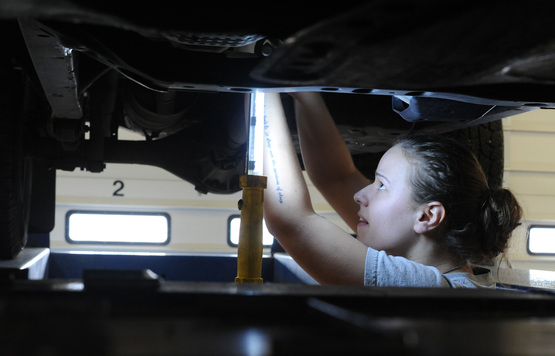








Don?t Be Hosed (Radiator Hose Replacement)
December 21, 2025
If you are like most drivers, you don’t worry too much about what shape your radiator hoses are in. But they are a vital part of your coolant system, helping carry engine coolant from the hot engine to where it is cooled off in the radiator.
When the cooling system has a problem, you will likely see your vehicle’s temperature gauge showing you it’s running at a higher temperature than it usually does. Or maybe the low coolant light has come on. If either of these happens, it’s important that you not drive too long since a hot, running vehicle can suffer expensive damage quickly.
Radiator hoses can be damaged by being subjected to temperature extremes, both hot and cold. In addition to the temperature gauge climbing or low coolant light illuminating, there are other clues that may tell you your vehicle is leaking fluid. You may notice a green, yellow, brown or purple fluid pooled on the ground around your vehicle.
At any of these signs, it’s time to bring your vehicle in for service soon. A technician can inspect hoses for leaks, deformities and other problems, as well as looking for cracks and wear. They’ll also check the condition of the water pump, since problems with it can be another reason coolant will leak out from under your vehicle.
It is better to periodically have your hoses checked rather than waiting until they fail. How often you should have yours replaced depends a lot on what vehicle you own, and in what conditions it is driven. Rubber degrades not only by temperature but also by what materials it comes in contact with. For example, oil leaking on a radiator hose can prematurely cause that hose to fail. Age is another factor.
We recommend you have one of our technicians inspect your cooling system regularly so you don’t get “hosed” by a failure at an inconvenient time.
ABC Auto Works
127 E. Walled Lake Drive
Walled Lake, Michigan 48390
800-742-4511
Need Service?
More articles from ABC Auto Repair & Tire Center

Smooth Moves
September 13, 2026
Stop for a moment and think of whats holding that heavy engine that sits under your vehicles hood to your vehicles frame. Your engine weighs hundreds of pounds, so its a big burden on those things that are holding it in place. Same is true for what holds your vehicles transmission in place. The... More
Helping Your Engine Breathe Easier
September 6, 2026
You may have heard someone tell you its time to replace your vehicles engine air filter and thought, Its OK. Ill do it in a while. While its tempting to put that off, keep in mind that having your engine air filter replaced is one of the easiest ways to maintain your vehicles performance and ef... More
Smooth Operator
August 30, 2026
Were used to bringing a vehicle to a stop and hardly noticing the engines even running when were sitting still. But sometimes you might notice it running rough when youre idling. Your vehicle is shaking, vibrating and making sputtering noises. You may even notice the tachometer on your instrum... More